


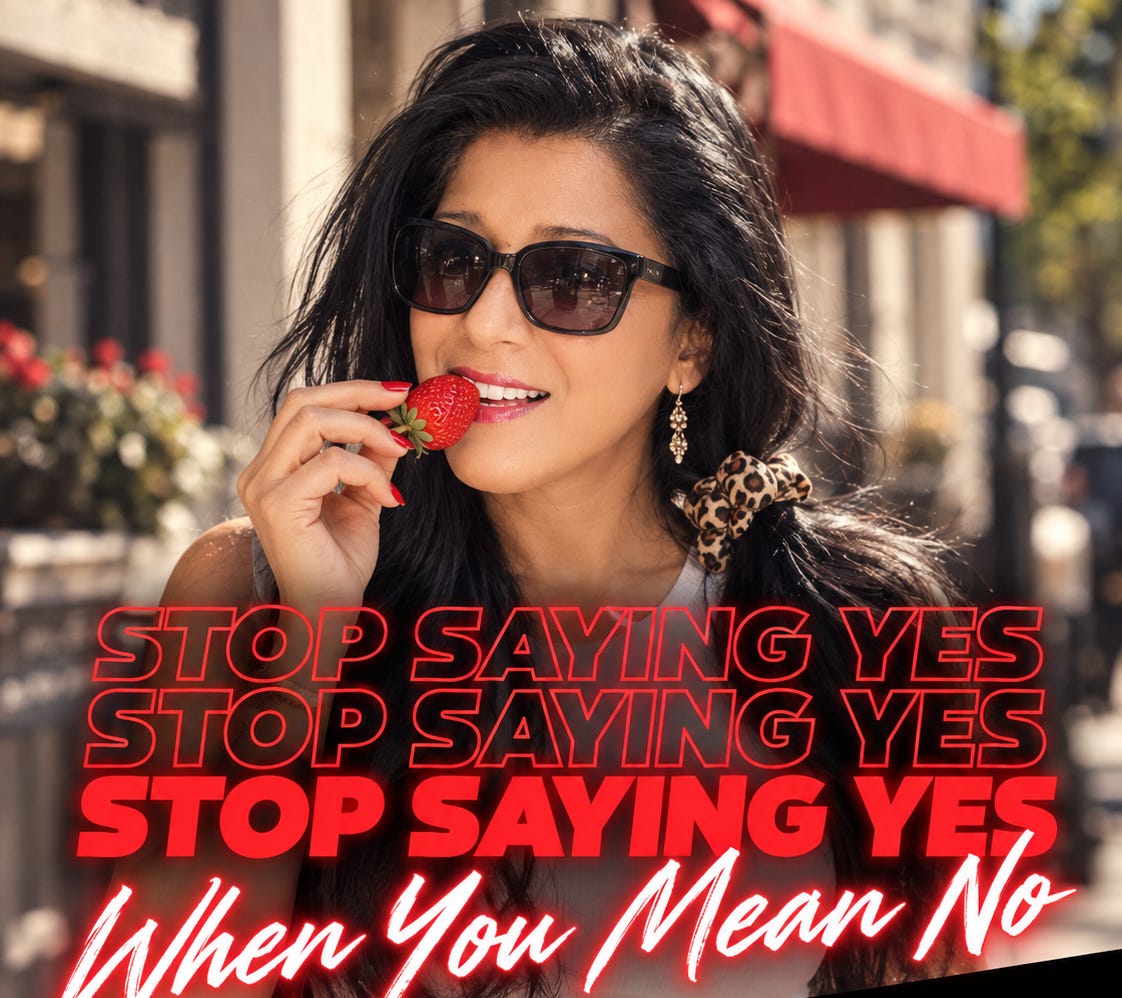
You can say no. Technically.
Actually you say it all the time. To the wrong supplier. To the project nobody bothered to scope. To the meeting that should’ve been an email. To the stranger who asks for five minutes and walks off with forty-five of yours.
So don’t tell me you don’t know what the word means. You know exactly what it means.
But then someone you love is disappointed. Someone at work says, “We really need you on this.” Your mother’s voice drops half a degree. A friend needs help. Again.
A perfectly reasonable request lands at exactly the wrong moment. And you know, you know, you don’t want to do it.
And out it comes. “Of course.”
Done. Committed. Your own answer didn’t even get a hearing.
And look, you probably have the scripts. You’ve maybe practised “No is a complete sentence” in the car. Fine. But in certain moments you’re ridiculously fast at three things. Working out what the other person needs. Calculating what it’ll cost you to disappoint them. And quietly deleting what you want from the list.
That’s a skill. Honestly. You’ve had years of practice.
Your yes doesn’t always look like people-pleasing
Sometimes it looks like leadership. Like being the one who can handle it. It looks like maturity, good judgement, generosity, loyalty, professionalism. Love, even.
Which is exactly why nobody spots it. Including you. From the outside it looks really competent.
So you rearrange your week. You fix the problem. You take the extra work, make the call, calm everybody down, remember the birthday, and translate everyone’s feelings into something the room can cope with.
And then it’s 2am and you’re lying there absolutely furious with people who probably have no idea a decision was even made.
Because as far as they’re concerned, they asked and you said yes.
The no did happen. It just happened in private. And you overruled it before it could get inconvenient for anyone.
When it really counts, your own no stops feeling like enough of a reason.
I know how small this can look. In 2003 I was a lead trainer in Jakarta. I was vegetarian and watching my figure, so at team dinners I’d order an €8 soup while everyone else ordered steak and wine.
Then the bill came. Split equally.
More than once I just said nothing, because I didn’t want to rock the boat. And when I did say something? I got called “cheap.”
So a question about a restaurant bill had turned into a verdict on my character. Over soup.
That’s what “just say no” leaves out. You can know exactly what you want to say and still see the label coming before you’ve even opened your mouth. Cheap. Difficult. Selfish. Not a team player.
Knowing the words is the easy bit. The hard bit is letting your own answer count.
The compliance machine
If you’ve become everybody’s reliable one, compliance almost never sounds like “I must obey.” Nobody talks to themselves like that.
It sounds more like this:
Be reasonable.
Don’t make this difficult.
You can cope.
It’ll be quicker if you just do it yourself.
They’ll be upset.
This is what a good mother / partner / daughter / leader / friend would do.
It’s not that big a deal.
And every single yes, on its own, is defensible. It’s one favour. One more deadline. One dinner you don’t want to go to. One conversation you put off. One decision you tweak so nobody else has to feel awkward.
None of it looks like a disaster by itself.
But you don’t get billed per yes.
You get billed for a whole life.
A calendar full of things you agreed to and never actually chose. A career built around what you were brilliant at carrying, not so much around what you wanted to make. Relationships where everyone can see how useful you are and nobody can quite tell what you actually want. Sometimes not even you.
I call that the Compliance Tax. It’s the time, the attention and the options you give up once keeping things easy for everyone else becomes your default setting.
And after a while, even asking yourself what you want starts to feel like an imposition. Like you’re being a bit much.
“But I chose this”
Okay. Maybe you did.
You chose the job, the marriage, the business, the kids, the responsibilities. The whole life.
You can love those choices and still ask whether every single arrangement around them has to stay exactly the way it is.
So here’s the question I’d actually ask. Am I choosing this now, or am I obeying some old idea of who I’m supposed to be?
A yes can be generous and still be yours. A sacrifice can come from love and still be yours. A responsibility can be heavy and still be yours.
What matters is who gets a say.
Did you choose it? Or did the committee choose it for you?
You know the committee. The Reliable One. The Good Daughter. The Professional. The Convenient One.
And to be fair, they all have excellent reasons. They’ve spent years keeping you included, respected and needed. They helped build the woman people trust.
They just don’t get to make every decision.
You get a seat at that table too. Even when somebody would honestly prefer you didn’t have an opinion.
You can understand the pattern and still repeat it

You’ve probably read the books. Done the therapy, or the coaching, or both. You know all about attachment and perfectionism and emotional labour and over-functioning.
You could explain your pattern with footnotes.
And you still hear yourself say yes while something in you goes very, very quiet.
Because understanding the machine doesn’t switch it off. Clearly.
What starts to switch it off is catching the decision while it’s happening. The request comes in. You have a reaction. You picture how they’ll react. And then there’s the answer you’re about to give.
That first reaction of yours is information. Listen to it. You can weigh it up against your responsibilities, your values, the consequences, all of it. You might still decide this is a hard yes you actually want to give. No problem. That’s a choice.
But your answer needs a moment where it’s allowed to exist.
Because underneath “How do I say no?” there’s usually a much harder question.
Who am I if I stop being the woman everyone can count on, at my own expense?
You can get so good at adapting that your own preferences start to feel like interruptions. So making room for them feels weird. Even when it’s something tiny.
So start with one you can actually see.
What’s one yes costing you?
Pick something you’ve agreed to this week. An extra task. A favour. Something you said yes to before you’d even looked at your own plans.
Then ask yourself:
What’s this actually going to cost me? Not just the thing itself. Count the prep, the travel, the follow-up and the headspace.
What gets moved or pushed back to make room for it? Be specific.
Now that I can see the cost, would I still choose it?
You might keep it. You might change the terms, ask someone else to chip in, or give a different answer next time.
The point is that the decision stops being invisible. You can see what you’re agreeing to, and what else you’re paying with when you agree.
You don’t have to stop being generous. Or competent. Or someone who cares about other people. All of that stays.
You just get to be in the room when the decision gets made.
The goal is to stop disappearing before you answer.
And then decide.
If this felt familiar, subscribe. It’s free.
I write about the rules we follow, the roles we get rewarded for, and what it actually takes to make a choice that’s really yours.
You’ll get the next essay in your inbox, plus an invite when my live workshop, Stop Saying Yes When You Mean No, opens for registration.